Investigation Log
Go straight to the Short Updates: March 2026 | November 2025 | September 2025 | August 2025
Issues Arising
Slightly longer posts that analyse an issue arising during the curriculum change process.
Top ^ ^short updates
Snippets of what I’m seeing and thinking now.
March 2026
18 March 2026
Rata is on a Mission to End Decolonisation's Success
It will be tempting for many to think that if science is behind the decision by the Ministry to stop printing 'At the Marae', then the decision is rational and thus one to accept.
But it is important to keep science, for all its value and wonder, in its place. As Guy Claxton said in my initial report into the subversion of democratic process by the MAG: "Science cannot tell you what you should do; that is the realm of philosophy and ethics. Science can only tell you what is possible or likely given certain values and aims."
Elizabeth Rata has been a constant presence in Erica Stanford's remodelling of our education system. She was on the MAG. She led the Years 7-13 English curriculum writing team.
On the morning of 20 October, 2024, she emailed Erica: "I was so pleased to have spoken with you yesterday and to have arranged to talk again", and attached the speech notes from "yesterday", with references "removed to the policy day in order to maintain Chatham House rules". These notes, she says, she "would be grateful if you can read them before we talk".
In those speech notes we read the following:
"Earlier this year I was privileged to be the Lead Writer for the years 7-13 knowledge rich English curriculum (and yes – Shakespeare and Grammar are there). It will be, I hope, along with still-to- be-written Science and History curricula, the circuit breaker in replacing the Learning Approach and ending decolonisation's success."
Rata is on a mission to end decolonisation's success. Given this stated aim by one of the more influential people in Erica's orbit, can we accept the decision to stop printing 'At the Marae' as science?
Rata's Belief in the Primacy of English
It is good to see people beginning to question the guidance Stanford is receiving, and from whom. It is clear that even from the earliest days of her role as Minister of Education, she was more inclined to defer to voices outside the Ministry.
I think we must see her decisions in that light.
Elizabeth Rata has been at the centre of many of the education initiatives since Stanford assumed office. She was appointed to the curriculum MAG, despite never being a name put forward by the Ministry – perhaps her long relationship with Johnston (Stanford's pick for Chair despite the Ministry recommending someone else) helped? She was the lead of the years 7-13 English curriculum writing team. She is on the Charter School Authorisation Board.
Rata does not hide her aim: curriculum as the "circuit breaker in replacing the Learning Approach and ending decolonisation's success". The English language plays a key role in that. That she has Te Whāriki in her sights is alarming.
For instance, she wrote to David Seymour this:
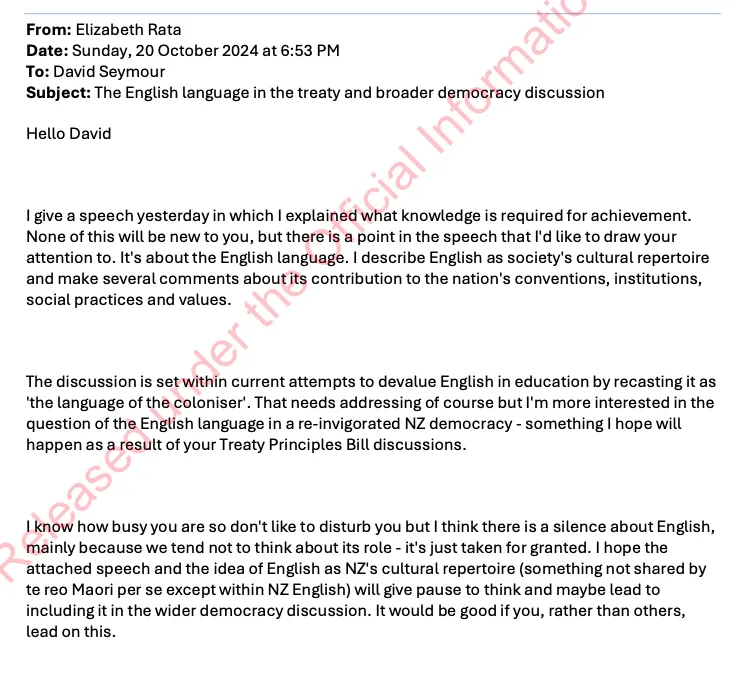
To which his response was, "This is absolutely brilliant. Thank you for sending it. You are by far the most articulate exponent of enlightenment thinking and need to get far more exposure."
This is the kind of ideological stew our ministers of education are swimming in. Rata constantly lands in their inbox, many of the emails referencing having met or spoken to them, with the content serving to keep the abreast of her latest work.
When someone is explicit in their aim to end decolonisation's success, when they state that English forms NZ's cultural repertoire, not te reo Māori, that the English language and a re-invigorated NZ democracy go hand-in-hand, and that person is a constant presence in key roles and inboxes, huge questions must be asked about the ideological foundations for these education changes.
Rata Was Appointed By Erica Stanford, Despite Ministry Recommendations
The plan to establish an advisory group to review the curriculum refresh work done to date was quickly actioned by Minister Stanford when she took office in November 2023. The Ministry attempted to make recommendations about its scope and makeup, but these were, in the main, unsuccessful, with the Minister being proactive in providing the Ministry with "feedback" on their recommendations.
As documented in my initial report into the MAG, this process was fraught, and the tussle is one that Stanford won.
Take, for example, the makeup of the MAG. In a Ministerial Briefing Note dated 4 December, 2023 (link since deleted) the Ministry provides a list of twelve names for the MAG. Four of those make the final cut: Michael Johnston (who is made chair by Stanford, ignoring the Ministry's recommendation), Christine Braid, Fiona Ell, and James Chapman. Braid, Ell, and Chapman had been involved in the refresh work done under the previous Government.
That means there were eight appointees to the MAG who owed their appointment to Minister Stanford. Elizabeth Rata is one of them. Melissa Derby is another.
While there is no requirement for an advisory group to be representative, this one is particularly narrow in its perspective: eight of the twelve had collaborated or worked with Michael Johnston previously, some of them often, either in academic research, think tanks, formalised ‘forums’ (eg, Open Inquiry) or other education advocacy work (eg, webinars such as this one): Elizabeth Rata, Melissa Derby, Amy Tan, Iain Taylor, Christine Braid, James Chapman and Helen Walls.
This tendency to surround herself with the like-minded is a pattern of Minister Stanford's tenure.
For another example, see the NCEA Professional Advisory Group. It is a tactic that lends itself to the projection of confident certainty, but closes her off to the diversity of thought that supports the good decision-making that effective governance requires.
Stanford is actively choosing to surround herself with people, like Rata, who have a stated aim of ending decolonisation's success, and who, like Derby, argue that structural racism doesn't exist. The kind of certainty they are leading her to, a certainty she is actively choosing to have reinforced by the voices she surrounds herself with, is leading her to reassert and embed a worldview that favours how we were.
Texts Suggest Minister Stanford Compromised the MAG's Independence
On 20 December, 2023, Cabinet approved the establishment of the curriculum review Ministerial Advisory Group (MAG), with Michael Johnston as Chair.
At 10:06am on 22 December, Michael texts Erica asking if she has time to discuss the MAG. She does, "in about an hour", but it doesn't happen, and so Michael texts again at 1:47pm.
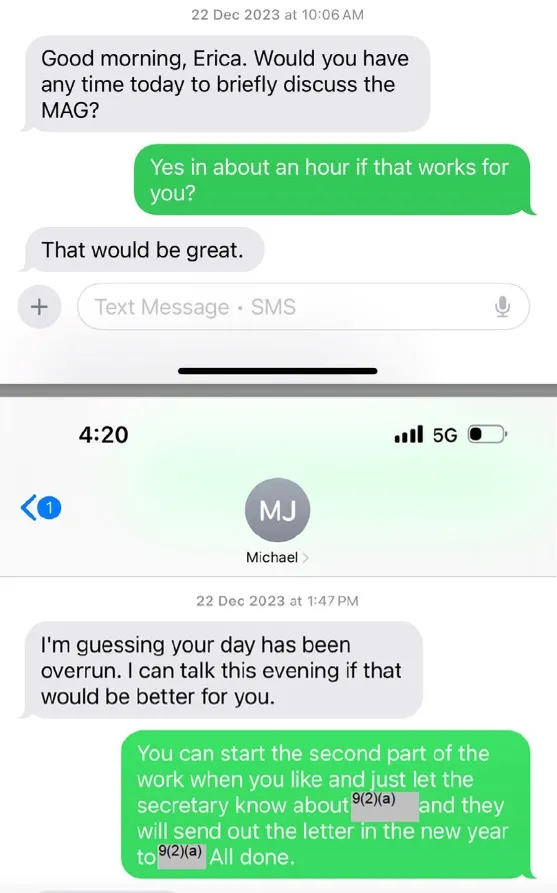
A phone call wasn't required, which suggests previous conversations had been had about the reasons for Michael wanting talk. One was to do with an individual in relation to the MAG (an addition?). The other is very curious.
What is the "second part of the work" that Michael gets the green light to start when he likes? The MAG had no second part in their Terms. This is important because the Public Service Guidelines state the Terms are a key way in which the "quality and independence of the advice" is protected.
This text raises the possibility of this MAG's independence being compromised from the earliest of stages. It is also clear evidence of the Minister's knowledge that the MAG was going to operate beyond their Terms. We know that an area in which they did this was in writing curriculum material, which is a violation of Public Service Guidelines. We know that the MAG referred to writing curriculum material as "their work" in communications with each other. We know that material was presented to ERO as the curriculum, not a sample to the Minister as the Terms allowed.
Is this text exchange evidence of the Minister giving the green light for that violation?
November 2025
24 November 2025
Stanford Admits Involvement in the Development of the Senior English Curriculum
While it is usual for a Minister to be aware of the different iterations of a curriculum, it is unusual for a Minister to have input.
And yet, this is exactly what has happened with the English Years 7-13 curriculum. Has it happened with others?
Erica Stanford, and her office, received a number of draft versions of this curriculum. This is typical. A Minister should be kept abreast of changes, including the rationale for them.
But Stanford has reached beyond this process into atypical Ministerial actions.
We know, thanks to an Education Report, that around 10 February 2025 Stanford’s office requested changes to the version of the senior English curriculum sent to her in early February. What those changes were I have yet to find out, as Stanford has told me she has no record of them.
However, I have found out that Stanford also received copies of the draft senior English curriculum on 14 and 27 March. This is significant. In an OIA response, Stanford confirms the content was “reviewed and feedback provided to officials in meetings”.
That’s right: Stanford played a role in the writing of the senior English curriculum, reviewing documents and providing feedback to Ministry officials on at least 10 February, 14 March and 27 March. This is highly unusual, for a good reason. Having separation between governance and operational roles helps limit political interference in the development of curriculum. It allows the experts to do their job. It allows for consultation to work through proper processes and not be unilaterally overruled.
March 2025 saw at least two versions of the senior English curriculum. We now have an admission from Stanford she was involved in them. One stipulated the inclusion of Māori and Pacifica authors, and Shakespeare was not included. In the version released to the sector at the start of April, Shakespeare was back, and Māori and Pacific authors erased.
It is hard to escape the conclusion that Stanford had something to do with the switch.
15 November 2025
Rata and Johnston's Involvement in the Takeover of the Ministry of Education
If there was ever any doubt about who was calling the shots regarding the curriculum rewrite, Michael Johnston made it clear on 4 April, 2024.
Elizabeth Rata had had her curriculum writing team organised from 23 March, including the venue (Auckland Grammar). But they hadn't been able to get started because they needed Stanford to accept the MAG's report and recommendations, which doesn't happen until 5 April.
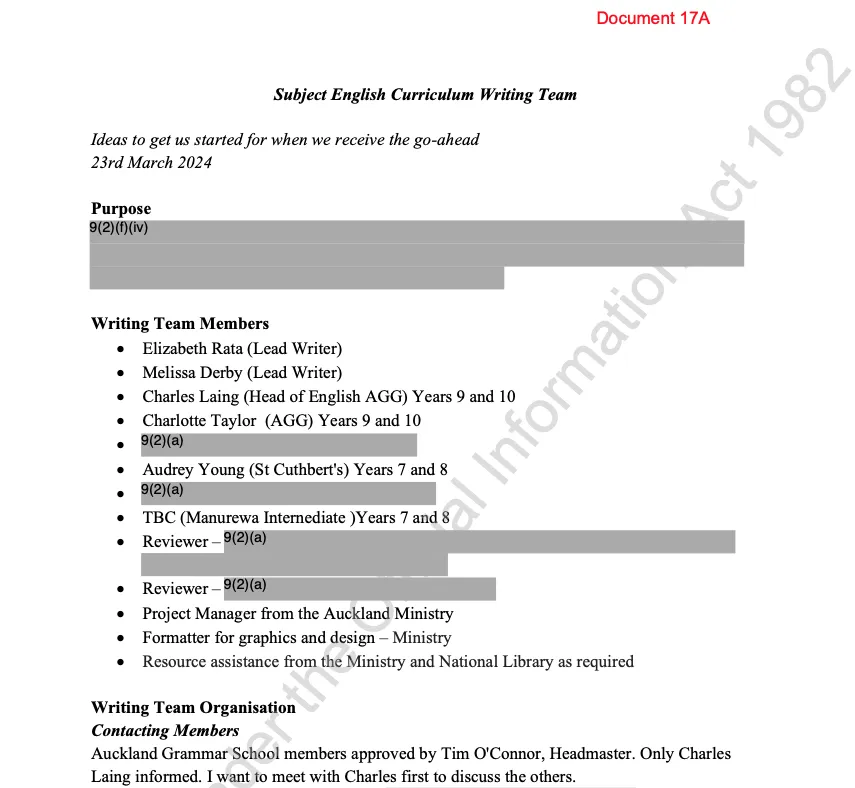
So, there is a sense of frustration in Johnston's email on 4 April to Anya Pollock at the Ministry:
"I’m at the NZ Initiative retreat … I understand that it’s the Ministry’s job to put together the writing groups, but they need to do so in consultation with key MAG members. In the case of subject English, that means Elizabeth."
The next day, Stanford accepts the MAG's recommendations, while she is at the NZ Initiative retreat.
Who is in charge here?
This is a clear case of an advisory group exceeding its statutory authority and seizing control of a government agency. And at the centre of this, we find Rata. We find Johnston, the chair of the MAG and the NZ Initiative's senior fellow leading their education work. We find a clear warning: the influence Rata was able to exert over the curriculum rewrite means that her now having Te Whāriki in her sights is something we need to take seriously.
3 November 2025
An Australian Company Is At The Centre Of Our Curriculum
Today, I had confirmation in an OIA response that Learning First, a education consultancy based in Collingwood, played a key role in the development of our national curriculum docs.
They provided “insights” to help the Ministry with international benchmarking.
Little more detail was provided, but I do wonder why our Ministry did not have that capability in-house, given the extensive curriculum develop process it has been going through for the last 5 years.
And I do wonder about the procurement process here. Were the services of Ben Jensen’s company procured under urgency, as the maths textbooks were?
It gets worse. When you visit Learning First’s website, what you find is a small consultancy that has produced a few reports and offers programs for “teachers, school leaders, and system leaders”. Has our Minister signed up to a PLD course?
It will not surprise you to learn that Learning First advocate for a knowledge-rich curriculum based in the science of learning. It is this they claim is the answer to educational inequality. And, worryingly given today’s announcement, in 2015 they wrote a report critiquing ITE in which they suggested the autonomy of universities was a problem.
Erica Stanford has met a number of times with Ben Jensen. It seems she is convinced enough by his arguments that she has been happy to hand him control over our curriculum development.
A curriculum by kiwis for kiwi kids? Not quite, Erica.
September 2025
30 September 2025
Stanford’s Curriculum Change Process: Erasure Of Māori And Pacific Authors Achieved By Violating Democratic Process. Yes, That Matters.
Amidst the propaganda blitz that Stanford has launched on the education sector, it might seem finicky for me to keep brining up issues around process. Surely, if Stanford’s arguments are right and a structured, knowledge-rich, assessment-driven system will solve the crisis she has diagnosed, then it really doesn’t matter how it’s put in place? In fact, given the urgency she has told us exists, isn’t it best to get the approach in place as fast as one can? – the ends justify the means. That is exactly the argument Ministry leaders have used in select committee.
But what do you expect from those with power when they are making decisions that affect you and those you love?
- Do you expect them to listen to a wide range of evidence and experts?
- Do you expect them to engage with multiple perspectives?
- Do you expect them to follow proper processes?
Because if you do expect these for yourself, you better defend them regardless of who is in office, and regardless of their policy programme.
Stanford’s curriculum change programme has only paid heed to one form of evidence – the science of learning, knowledge-rich, and structured approaches crowd. These approaches work for some learners and have some merit, and place, but are all far from settled as whole system approaches.
Stanford’s curriculum change programme has not engaged with the wide diversity of experience, culture, and needs in the sector. She seems to have been overly reliant on the ideas of the likes of Elizabeth Rata and Michael Johnson.
Stanford’s curriculum change programme has failed to adhere to regulatory and public service guidelines and processes, the very things that act as guardrails to protect the integrity of our democracy, and thus you and your place and voice in this country.
As a result, we end up with situations like the senior English curriculum being changed at the last minute, in a way that makes it a fundamentally different document from the one that was about to go to the sector. It is hard to see how those changes could have been done in a way that followed process.
And yes, it does matter that those changes resulted in the removal from the curriculum of Māori and Pacific authors. It does matter that they were replaced by Shakespeare and 19th century texts.
Who did this? On what basis? Who was consulted? Who advised? Why did Stanford approve this version?
If we let this slide, follow the logic and you end up with power that is unbridled, that can operate with impunity, and that is more likely than not to act in the interests of the few.
If that becomes the way power operates in this country, what are you going to do when the other team assumes power?
29 September 2025
March 2025: Two Senior English Curricula
Just think, English teachers of Aotearoa New Zealand: there was a March 2025 version of the rewritten senior English curriculum that didn’t fully embrace Rata’s determination to “end decolonisation’s success”.
That version instructed you to help students explore Aotearoa New Zealand perspectives, and said you must include Māori and Pacific authors in your teaching programme.
But that version is not the one we saw.
We were asked to consult on a version where the stipulation to include Māori and Pacific authors was erased, as was the word perspectives: instead, students are to understand Aotearoa New Zealand, not Aotearoa New Zealand perspectives.
In their place, you were told you must teach Shakespeare and 19th century texts.
Someone made these changes just before it went out for consultation. Who was it, and how aware was the Minister?
What we do know is Elizabeth Rata was involved in writing the curriculum, and was so pleased with the final document that she wrote to the Minister in April to congratulate her. The senior English curriculum “is the knowledge-rich curriculum you promised … Your leadership in driving this herculean task deserves to be recognised”.
17 September 2025
Stanford Says She Will Remove Te Tiriti From The Education and Training Act In One Go
On 23 July, 2025, Stanford spoke to Sean Plunket on The Platform. He wanted answers about the place of Te Tiriti in the Act.
Plunket: Is it going to stay in there? (from 7 mins)
Stanford: … I don’t want to be doing this five or six times. I want to do it once and I want to do it right … There will be changes.
Plunket: Will they be the changes that the people who are making smoke come out of my text machine right now will agree with?
Stanford: I think that they will. But, they need to wait. It is important that we get it right … I don’t want to be talking about the Treaty, I want to be talking about reading, writing, maths, achievement.
Plunket: So the way to do that is get the Treaty, get all this Treaty stuff, out of education, right?
Stanford: In one go.
This interview supports the one that Plunket had with Michael Johnston on 4 July, where he said that Stanford was being politically sensible to not remove it at this point.
I have wondered about the extent to which the ideological positions Stanford has been repeatedly exposed to from Rata and The New Zealand Initiative would influence her thinking. We saw Stanford echoing Rata’s views about cultural responsiveness being a “misdiagnosis” of our education challenges when she was on a stage in Florida in late June, 2025 – a glimpse that that exposure was influencing her thinking. And here we have Stanford explicitly stating a position that aligns almost exactly with Rata and emails she sent to Stanford and Luxon in late June, 2025.
Why does this matter? – All politicians are influenced by thinkers and ideology.
The issue we have with Stanford is she has repeatedly allowed those thinkers, who are at the extreme end of right-wing thinking, to influence and direct the work of government in ways that go against the spirit of or violate public service guidelines and democratic process. This video is clear evidence that Stanford shares one of their key aims, and she is going to make use of “legislative vehicles that are coming up” to realise it, “soon”. We should all be alarmed that one small group is able to exercise such power.
This not-so-slow erosion of democratic guardrails is a warning sign, identified by democracy scholars like Levitsky and Way, that we are experiencing democratic backsliding. That is how all of us, bar a select few, lose our voice, any chance of meaningful participation, and our dignity.
15 September 2025
Rata and Te Tiriti o Waitangi: Her Lobbying Of Stanford and Luxon For Its Removal From the Education Act
Elizabeth Rata has had a significant influence on the direction of education over the last 18 months. So, what she believes is important, especially given those changes have been driven and done by a small group of ideologically aligned people. We know of their connections to the NZ Institute, part of the Atlas Network. The question is, how has that impacted the work of that group? One place we can look is their actions as individual citizens, including how they interact with the democratic process in that capacity.
In her submission on the amendments to the Education and Training Act, Rata gives us her starting position regarding Te Tiriti: it is something we can believe in, or not (just like Christmas).
Some New Zealanders believe fervently that the Treaty must be honoured. Others do not – equally fervently. For some the Treaty is our nation’s founding document. Not so for others. It is a sacred covenant with a timeless spirit for some, but merely an historical document for others. Some believe it is the nation’s constitution. Others believe it is not. As with all beliefs, there is no proof either way, no right or wrong. You either believe or you don’t.
It follows, therefore, that when “belief is inserted into legislation however, the belief acquires the status of doctrine. It is then treated as if it were a true fact.”
To be clear, Rata believes that Te Tiriti has enabled a decolonising approach to education that, with its focus on cultural responsiveness, is nothing more than a doctrine.
It is worth remembering that Rata is someone who has been at the centre of Stanford education changes: on the curriculum MAG, leader of the English Years 7-13 writing group, on the Charter Schools Establishment Board. She has been an active presence in Stanford, Seymour, and even Luxon’s, inbox. For instance, on 22 June, 2025, she emails Stanford regarding the Act’s amendments.
And then seven days later, she emails the Prime Minister.
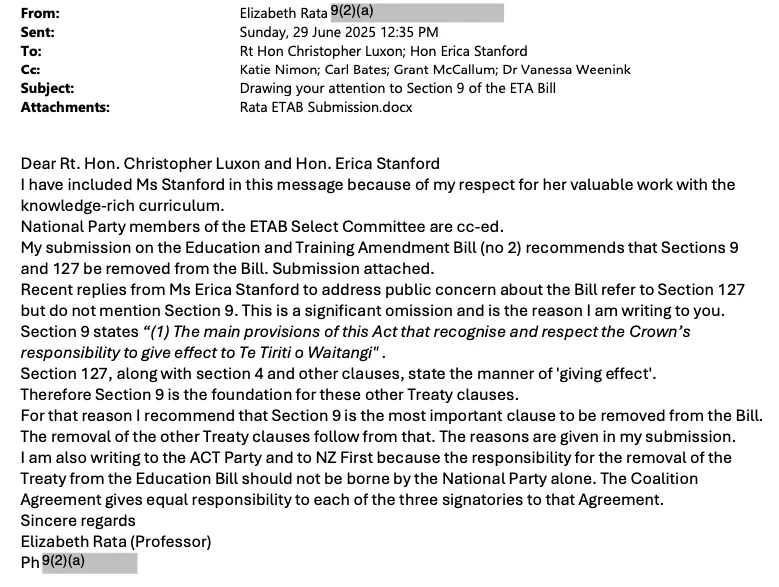
This is not anyone. Rata is an insider whose opinion is valued. For instance, she presented, and was on a panel, at the National Party Northern Region Policy Day on 19 October, 2024. That was where she declared her desire to use curriculum to end decolonisation’s success. And Seymour has professed his admiration of her and her work: “You are by far the most articulate exponent of enlightenment thinking and need to get far more exposure.” – Seymour to Rata, 24 October, 2024.
The issue, as I see it, isn’t that Rata has these beliefs about Te Tiriti and its place in our education system. We are all entitled our opinions.
The actual issue is this. At the heart of our Government we find someone who considers Te Tiriti a belief system not a fact being granted continual access and influence. Who is granting that? And why?
ESOIA640 Stanford & Rata Comms Aug 25
11 September 2025
There is No Budget for the Scrapping of NCEA
In a debate in the House last evening (10 September) about the education estimates in Budget ’25, Lawrence Xu Nan pointed out that it doesn’t provide anything for the scrapping of NCEA. He asked how much Stanford is intending to budget or add to a supplementary budget for that work to be done.
Stanford stated she could not answer that question because that work is not in the Budget. And then she confirmed: “nothing has been budgeted for”. (3:43 timestamp/17:43pm)
The Opposition found this difficult to understand. Willow-Jean Prime stood and detailed the kind of work required for the scrapping and replacement to be successful, ending: “Surely the Minister and Ministry have done some thinking about this”.
Short answer: no, they haven’t.
2 September 2025
The Narrowing of the Curriculum is the Point: That is How Erasure is Achieved
When Stanford took office, the Ministry’s briefing documents were keen to stress the re-balancing work that had been done to date, but warned against “centrally setting a highly detailed teaching programme”. To do so would be a “significant departure from evidence about the value of enabling and expecting the profession to respond to individual learners needs and interests”.
This position is still evident in early March, 2024. In the agenda for the Curriculum Deep Dive Session on 6 March, after detailing Stanford’s six point plan, the Ministry make the following point:
“there will be significant anxiety in the sector that there is an intent to narrow the curriculum and standardise teaching to such a degree that teachers and kaiako feel they cannot respond to their students’ needs. This includes their ability to design teaching and learning programmes that contextualise the national curriculum with contexts that are meaningful and engaging for their students or that matter to their local curriculum.”
What was the outcome, as directed by Stanford? Fidelity to the national curriculum was to be prioritised. And so the Ministry set to work “deliberately shifting away from the language of school or local curriculum”. This shift became a focus of the changes to the Education and Training Act, despite Ministry warnings it will impede schools in meeting their obligations to Te Tiriti, as local curriculum was how they were enabled to do so in the legislation.
But it wasn’t just the Ministry warning of the narrowing. ERO’s international panel of evaluators of the rewritten English and Maths curriculums raised it as an issue in September, 2024.
When evidence and advice is repeatedly ignored, a logical conclusion is that he narrowing is the point.
When it is Māori knowledge and support that is repeatedly erased, a logical conclusion is that one culture is being asserted over all others.
When the Minister says the being culturally responsive is misdiagnosing the problem, a logical conclusion is that Stanford has listened to Rata and is sympathetic to her mission to end decolonisation’s success.
1347116 March 2024 Curriculum Deep Dive Session Minutes May 25
August 2025
31 August 2025
Te Tiriti At Risk Of Removal From the Education and Training Act.
Is Erica Stanford woke for keeping reference to Te Tiriti in the amendments to the Education and Training Act? That’s a question that has been vexing a number of people on the right.
On 4 July, 2025, Michael Johnston went on The Platform to defend her from that accusation. His defence wasn’t that keeping reference to Te Tiriti is essential, but that Stanford was being politically sensible to not remove it at this point. He pointed to Stanford saying in “another interview” that Te Tiriti “would be considered under” Minister Goldsmith’s “omnibus reform of legislation”, so avoiding a “fight with the school sector” is the right thing to do while she focuses on driving curriculum reform.
Of particular note, in his defence of Stanford, Johnston challenges anyone to go and look at the new English and Maths curriculums and “find any evidence of woke material”. Make of that what you will.
Why should we be alarmed?
In case you need reminding, Johnston was Stanford’s choice to be MAG chair despite the recommendations of the Ministry. That very same MAG,
- gained oversight of curriculum writing groups within the Ministry two weeks after its first meeting,
- wrote curriculum documents despite being told that was the work of government,
- presented those documents to ERO as the curriculum during the QA phase of the curriculum development process,
- and saw a number of people move from being MAG members to being key personnel on the ‘official’ curriculum writing teams (I say ‘official’ because the Ministry, despite officially putting them together, was operating under instructions from the MAG, who got to choose who was on those teams),
- has a key member, Rata (who we can only assume made the MAG on either Johnston or Stanford’s recommendation, as she wasn’t on the suggested MAG member list provided by the Ministry) on record as wanting to use curriculum to “end decolonisation’s success“.
Let’s lay this out. Plunket’s main criticism of Stanford is she has missed an opportunity to make good on the Government’s promise to remove reference to Te Tiriti in legislation. Johnston’s argument to that is, essentially, keep the faith – look at what she’s done already with the curriculum, and remember what she has said about Goldsmith’s work.
So, we should be alarmed because here we have a close aide of the Minister, who has successfully directed curriculum change as ‘directed’ by Stanford, suggesting they’re not done yet.
20 August 2025
Stanford Knew the MAG Was Violating Public Service Guidelines
On 6 March, 2024, a Curriculum Deep Dive Session was held in the Ministry.’s executive wing. In attendance were Iona Holstead, Pauline Cleaver, Kiritina Johnstone, Julia Novak, and Ruth Shinoda, as well as Minister Stanford.
An annotated agenda helped to frame that meeting. That included an update on where things were at regarding the refresh of the curriculum. In that update we find this regarding the English and Maths curriculum: “Currently being reviewed and rewritten by the MAG”.
This is a violation of Public Service Guidelines. The Ministry knows it. That is why Ellen Mac-Gregor Reid denied it had happened when questioned in select committee, but was forced to admit it did occur under questioning by Lawrence Xu-Nan. Why mislead Parliament if it is a small matter of no consequence?
But of course, it is a matter of significant consequence. The curriculum is secondary legislation. It sets out how a school will meet its obligations under the Education and Training Act. Therefore, only a government agency has the authority to write it.
The MAG is not a government agency. It is a collection of private individuals contracted to offer advice to a minister within a defined scope.
Even more damning, the Minister knew and did not stop it. Is that because she had lost control of the MAG, or because they had her consent? One thing we can refer to that suggests the latter is more likely, is the text message Stanford exchanged with Johnston, the MAG’s chair, on 22 December, 2023. In that exchange, she gives him the green light to start “second part of the work”.
Is rewriting the second part?
1347116 March 2024 Curriculum Deep Dive Session Minutes May 25
ESOIA506 Stanford & Johnston May 25
19 August 2025
‘Make it ???’ … Stanford’s Action Plans and the Commercialisation of Public Education
In an article by Laura Walters published on 18 June 2024 on Newsroom, Walters writes, “While it had not been officially recommended, the minister has mentioned Prime Maths could follow on from her structured approach to literacy.”
This is a breach of the Cabinet Manual, specifically Clause 2.106: No Minister should endorse in any media any product or service.
But it gets worse. As my report into the maths textbook procurement showed, we also know that:
- Prime Maths had an established relationship with Stanford.
- Stanford did not disclose this relationship to Parliament when given a chance to via a Parliamentary Written question.
- Stanford signed off on the procurement criteria for the maths textbooks.
- Prime Maths became one of four successful tenderers, all of whom are off-shore publishers.
And, a reminder that the recent removal of te reo Māori from textbooks isn’t an isolated case, the $30 million/year funding for that contract was taken from the Te Ahu o te Reo Māori initiative.
Today’s announcement of the Make it Write action plan echoes the Make it Count action plan: a reference to alarming data; a solution based on structured approaches and ‘resources’.
But is that data valid? As Stanford said, “the results were measured against the new curriculum expectations which were higher, because “it’s where children need to be”.” Remember, that is the curriculum that ERO’s quality assurance process deemed to be unfit for use.
$150 million is going into the commercial provision of the structured literacy PLD to support this action plan. There are a number of individuals who were on the MAG and curriculum writing teams who are also commercial providers of structured literacy PLD.
A “few million” are going to the digital writing tool: is that a Ministry developed tool, or a commercially provided one? Remember: the maths textbook procurement was run as a closed tender, justified under urgency.
ESOIA507 Stanford & Scholastic May 25
13 August 2025
Stanford’s Emails Reveal External Influences on Education Decisions
On 22 January, 2024, Stanford emails Michael Johnston, the chair of her Ministerial Advisory Group, from her personal gmail account with this curious message: “I will ring shortly. Please find attached the version of SLOs that we sent to the MOE and the response we received back.” Attached are the ‘Earth & Space Science Learning Outcomes For Assessment: Companion to the NCEA NZC Level 1 Earth and Space Science Learning Matrix’.
Why is Johnston part of this conversation?
On 24 January, 2024, Johnston replies: “I’ve had some additional thoughts about the Learning Objectives documents after speaking with [redacted] earlier today. I apologise for not realising these things sooner.”
It appears they have talked, and that Johnston is part of Stanford’s decision-making team.
This is a problem. He is not a Ministry employee, and his has nothing to do with the MAG, being far out of its scope.
What this demonstrates is Stanford is willing to be guided by voices outside of the Ministry, such as Johnston. PRIME Maths helped her decision-making regarding the Maths curriculum. Rata certainly seems to be of the opinion she has a voice too, probably because it is clear Stanford wanted her involved in the curriculum review.
Against this background influence, it is alarming the extent to which this Minister is involved in the minutiae of pedagogical decisions, like the removal of te reo Māori from textbooks. It represents a pattern of her being involved in operational matters — highly unusual behaviour for a Minister — where decisions made consistently favour the interests of those external parties.
ESOIA506 Stanford & Johnston May 25
12 August 2025
The Ministry of Education Admits They Are Probing For Evidence Of School Compliance, Not Student Achievement
In the December 2023 Select Committee, Jan Tinetti asked the Ministry of Education leadership team what evidence they would be collecting in relation to the impact of the Maths textbooks, curriculum, and PLD (circa 54 minutes).
Pauline Cleaver replied: “We’ll be evaluating the use of the resources alongside the PLD and of course the implementation of the new curriculum”.
Note that word use.
For Ellen MacGregor-Reid conceded a couple of minutes later that, while they have ERO doing “evaluation probes”, Tinetti had raised an important point (the bolding is mine):
“it does bring to the fore the need for that evaluation, sorry the assessment information at some level. You will have seen the auditor general’s report on equity and the importance of that information around actual student progress and achievement and I think if we’re really going to know if this is making a difference the information you have needs to move to the level of, are we seeing the shifts for students as well?“
At some level. As well.
This regime is not, first and foremost, probing for effectiveness. It is probing for compliance.
Is that because they are certain these changes will lift achievement? If so, where have they got their information? Given Erica’s undisclosed relationship with PRIME Maths, and their effective lobbying of her, I think we are within our rights to raise an eyelid here.
Because, given the reliance on commercial products and support to drive the Maths curriculum, the probe for compliance is actually a way of driving commercial profits from the public purse by ensuring schools have no choice but to use them.
Have you experienced this probe for compliance in your recent dealings with ERO or your Ministry Advisor?
11 August 2025
Minister Stanford’s Ties to PRIME Maths: A Red Flag
When asked in Parliamentary Written Questions (PWQ), “Did the Minister make any recommendations to Ministry of Education officials about suitable providers of the math resources before, during or after the Request for Proposal had closed; if so, how did the Minister become aware of those providers?”, Stanford replied:
“No. I approved the criteria for selecting maths resources though the procurement process, but I have not made any recommendations about suitable providers before or during the procurement process. I was made aware of the approved providers once the procurement process had been completed. From talking to principals and teachers I was aware of some of the resources schools are using.”
Stanford had an ongoing relationship with PRIME Maths, stretching back at least 18 months. PRIME Maths are the ‘inventors’ of structured maths. They became one of the successful tenderers. Stanford has not, to my knowledge, disclosed this relationship to Parliament, even when given the chance to in PWQ. The very fact of its existence means she should never have been approving the procurement criteria.