
Here are my thoughts on the draft English curriculum, with a focus on Years 9 to 13. In short, I think it is an impoverished document, despite its claims to represent a knowledge-rich approach to education, that instead reflects a highly ideological position regarding the purpose of an education system. In order to make real that ideological purpose, the curriculum has been reduced in scope, therefore severely limiting the potential for learners to engage with and flourish within English as a learning area.
I have come to that conclusion after spending significant hours trying to wrap my head around what it is asking of teachers and learners, and trying to use it as a foundation for my Term 2 planning.
Before I go on, I should declare my own ideological position. I believe in education as a democratising force, which should also be democratic in nature in a classroom. My thinking is influenced by the likes of Dewey and Vygotsky, and latter-day scholars such as Holt, Carr, Paley, Claxton, Bishop, Perkins, MacFarlane, Reynolds, and Locke among others. All of these have influenced my thinking about the draft curriculum. This post especially draws on the ideas of Locke, ideas which he develops in a forthcoming article in NZJES.
English as a subject has the potential to be a rich learning area. However, that richness stems from the broad ways in which it can be engaged with, which can be described in the following way. We can think of texts as:
- things to be revered,
- sources of personal inspiration,
- models that help us understand language and how it ‘works’, and
- commentary and critiques, helping us to think about the world and issues like social-justice.1
Engagement with texts in all these ways requires and develops knowledge. In the rest of this post, I will deal with each of these ways in turn, and connect them to the kinds of positions (we can think of these as dispositions: ie, do they invite students to be curious, persistent, etc) they encourage learners to take in relation to a text approached in that way. Those positions have clear connections to the education and learning objectives as stated in section 5 of the Education and Training Act, objectives a well designed curriculum should clearly enable a school and classroom to meet.
What are the objectives in the act?
There are three, and they are detailed in section 5 (4).2
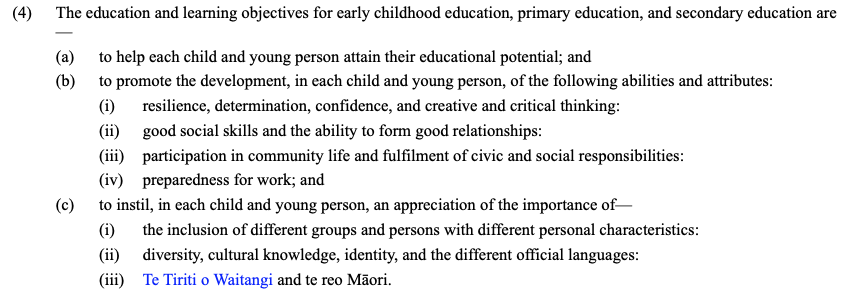
So, (a) is about academic achievement, (b) is about dispositions and competencies, and (c) is about inclusion, culture, and the bi-cultural foundation of Aotearoa New Zealand.
A curriculum should enable a school to realise those objectives, and sets out how the learning areas are to facilitate that, primarily in the classroom or learning experiences.3
Putting aside the very narrowing framing of (a), a significant problem this draft curriculum has is that it does not make it clear how the school is to meet its obligations for (b) or (c). Given my expertise sits in objective (b), I will now unpack that a little.4 You might want to read on if you are interested in thinking deeper about the problem this draft curriculum poses, and perhaps how you might go about adding your own feedback on the document.
Subscribe to get access
Read the rest of this post for a one-time payment of $2.
 Democracy Begins In The Classroom