
Let’s remind ourselves of the purpose of a ministerial advisory group or committee (MAG). Here is what the Public Service Commission says:
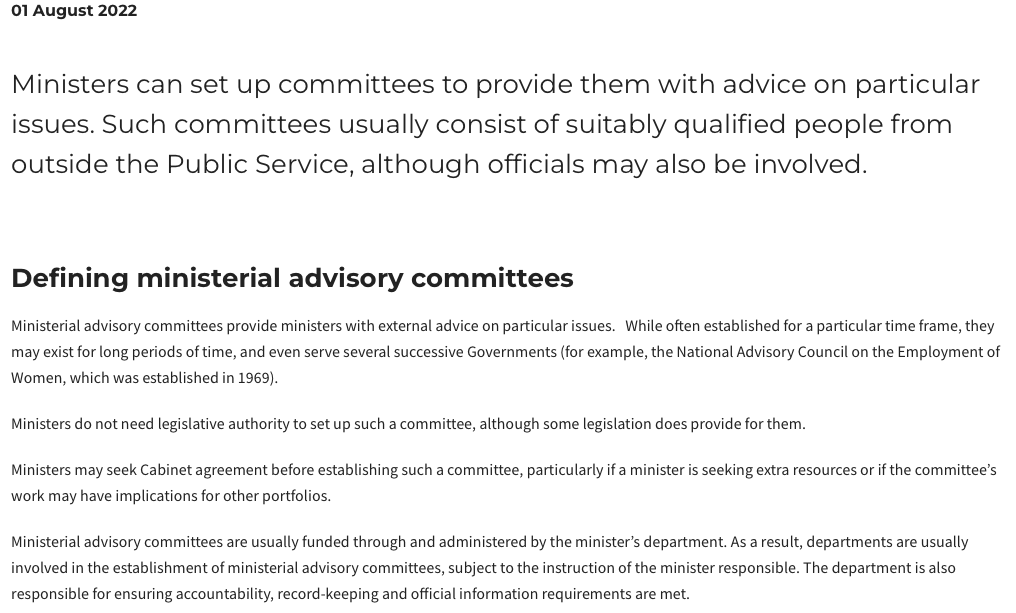

Importantly, it is stated very clearly that “a ministerial advisory committee should not undertake activities that cut across the responsibilities of the minister or the departmental chief executive, or it does not have the legal authority for.”
So, what reasonable conclusions can we draw from this guidance?
- The work of the group is framed by its terms of reference.
- They provide advice to the Minister, not the department.
- Their lack of a statutory basis means they are unsuited for developing regulations or the delivery of regulations. (A national curriculum document is a regulatory document, so a MAG should be nowhere near the development of one).
- If the intent is to exercise public powers (like the stipulation of how teaching and learning IS to happen), they are inadequate.
Key parts of the terms of reference for the education MAG were:
- Report to the Minister on how the English and maths learning areas, common practice model and phase by phase guidance work together to provide teachers with the clarity needed on year-by-year teaching expectations and how they embed effective practices that reflect the science of learning.
- This would include providing advice on the first three phases (ie, up to year 10).
- The report may include advice, feedback or draft/sample material for the Minister’s consideration.
- Once the advice is finalised, the Minister is to decide which of its recommendations to progress further.
We know the MAG interpreted the terms giving them leeway to draft material as meaning they could write the curriculum documents. (Ref to a 13 February email from Michael Johnston to Anya Pollock.) We know that this interpretation was pushed back against by the Ministry.
The MAG’s report was published on 19 March. You can read it here.
What is becoming of significant interest to me is what was going on in the immediate lead-up to that date. For instance, on 15 March, Michael Johnston emails the MAG to say he had met with Ministry officials “to plan the project ahead”, that the MAG “will have strong input into who these people will be”, and he is going to email the Minister to “find out exactly what detail the Minister would like to see in the report”.
This feels unusual. Isn’t the advice meant to be independent? I have an OIA request in seeking the detail of that email from Michael Johnston to the Minister. The Minster, in her response to a written question submitted in Parliament by the Hon Jan Tinetti about the project he mentions, says “I don’t know what Mr Johnston was referring to as I was not included in the distribution of this email and I have not seen it.”.
Also, on 15 March, an Education Report called ‘Implementing a structured approach to literacy in schools and kura’ was provided to the Minister. It is a report the Minister has annotated. I think the report is significant because:
- It is four days before the MAG publishes its report.
- It suggests work is already underway on what the MAG ultimately recommends in its report.
- The MAG is an active participant in the work.
- The Minister is aware of this work.
For instance, the Education Report says:

This reads like what the MAG recommends in its report, except it hasn’t been published and none of its recommendations have been accepted by the Minister. So, why is the Ministry framing the curriculum refresh as if these two things have happened?

In other words, the MAG have continued to be involved in the writing of curriculum documents, and while these are in draft form, the fact the Ministry is now working with them lends them an air of permanence.

And that air gains credence here: the Ministry wants confirmation that the work the MAG is doing (with the LCG), work, remember, the Public Service Guidelines are clear in stating they are not suited to, is intended by the Minister to be implemented.
With all this occurring before the MAG’s report being published, no advice has been finalised. So the Minister has not had the opportunity to decide which of the recommendations to progress further: remember, this is one of the terms of reference for the MAG.
But it really does seem that things are being progressed further.
This raises some questions:
- What has the Minister said, and to whom, that has led to the Ministry seeking confirmation the Minister wants the draft content implemented, which includes it being tested in schools?
- What has the Minister seen for her to want this draft content implemented?
- When, and how often, did she see the draft content?
- If she hasn’t seen the draft content, why is she sure it is appropriate?
- When did the curriculum rewrite actually begin?
- Is this really advice that’s being given?
Let’s go back to the Public Service guidelines.
- The work of the group is framed by its terms of reference.
- There is evidence the MAG pushed against these by stretching what can reasonably be interpreted by the word draft, continued to do so even after being cautioned by the Ministry, and that drafting was eventually supported by the Ministry. Has the Minister failed to adhere to them also, by seeming to ok work that reflects strongly the recommendations of the MAG prior to the publication of their report with those recommendations?
- They provide advice to the Minister, not the department.
- Why was the Ministry working closely with the MAG Chair? And, why is the MAG Chair wanting to know what the Minister wants in the report?
- Their lack of a statutory basis means they are unsuited for developing regulations or the delivery of regulations. (A national curriculum document is a regulatory document, so a MAG should be nowhere near the development of one).
- The draft content being developed looks like it was intended by the Minister to become incorporated into the structured literacy approach, which as you are no doubt aware forms the backbone of the new curriculum.
- If the intent is to exercise public powers (like the stipulation of how teaching and learning IS to happen), they are inadequate.
- The highly scripted nature of the new curriculum acts as to enforce a specific approach to teaching. That it seems the MAG has had significant input into the development of these, including working with the LCG to develop material for testing in schools and its members becoming key members of the curriculum writing groups once it was disestablished, is a highly concerning contravention of public service guidelines.
Those guidelines are there to preserve democratic process and protect against corruption.
 Democracy Begins In The Classroom