
Is our education system in crisis? That, certainly, seems to be the assumption our Minister is operating under. But is that assumption justified, and if it is, is the crisis pervasive across all parts of the system, or is it specific to certain parts?
Fortunately, there is a wealth of achievement data available that can help us think about this. What that data shows is that Aotearoa New Zealand has a relatively high performing education system, although that performance has declined since 2000. At a ‘whole of system’ level, there is no justification of a crisis. However, the system does struggle to meet the needs of Māori and Pasifika students, with the level of underachievement for those students justifying an urgency of action one would associate with the word crisis.

While there is a significant gap between us and Finland, I think it is significant that Australia and the UK — both influential in our Minister’s thinking — have been experiencing significant declines in this ‘outcome’ since the mid-2010s. The upturn in our data returns us to pre-covid levels of attainment, which were getting close to the levels we had at the turn of the century.
Comparatively, this data presents us in a positive light. NCEA L2 is a gateway qualification, enabling students to access tertiary study, and so is a marker of educational success. But is this success evenly distributed? In short, the answer is no. There are significant disparities between ethnicities.

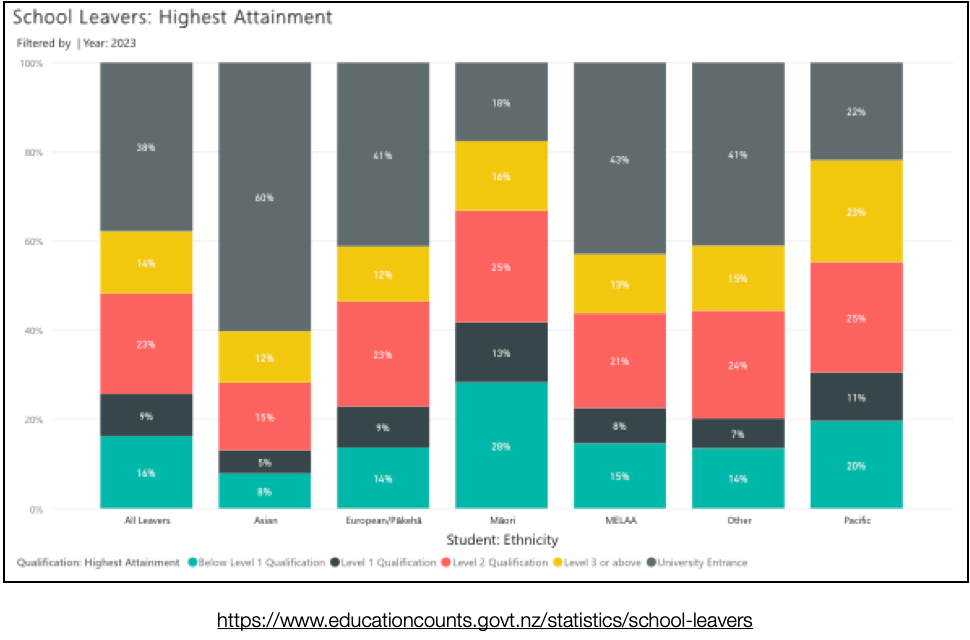
This is a picture that is even worse when you look at the highest qualification students leave school with. The green represents students leaving with less than NCEA L1 — essentially, no qualification. This is 14% of students system-wide, but 28% Māori and 20% Pacific.
This disparity begins early. It is present in mathematics data in Year 4.
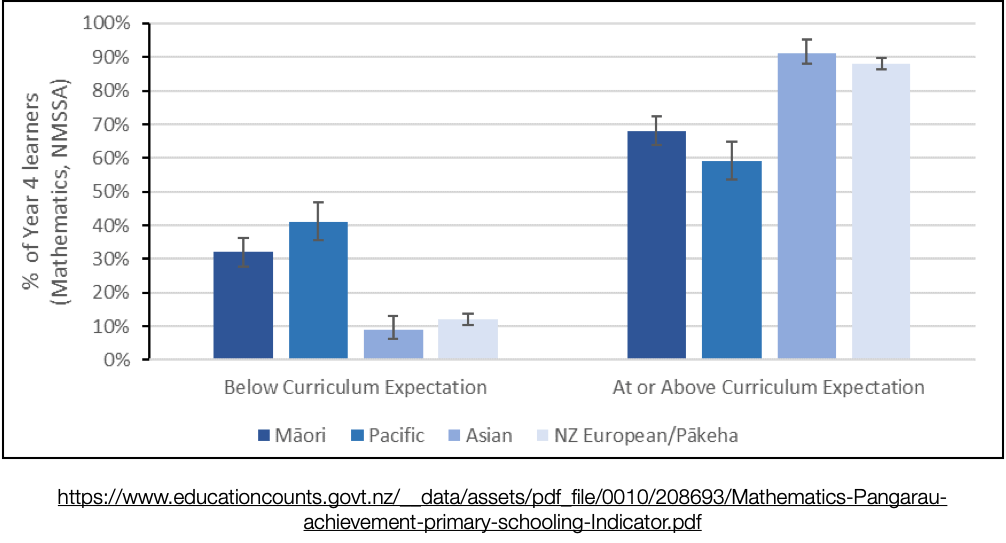
And, while all ethnicities show higher levels of being ‘below expectation’ in Year 8, for Māori and Pacific students it has reached alarming levels.

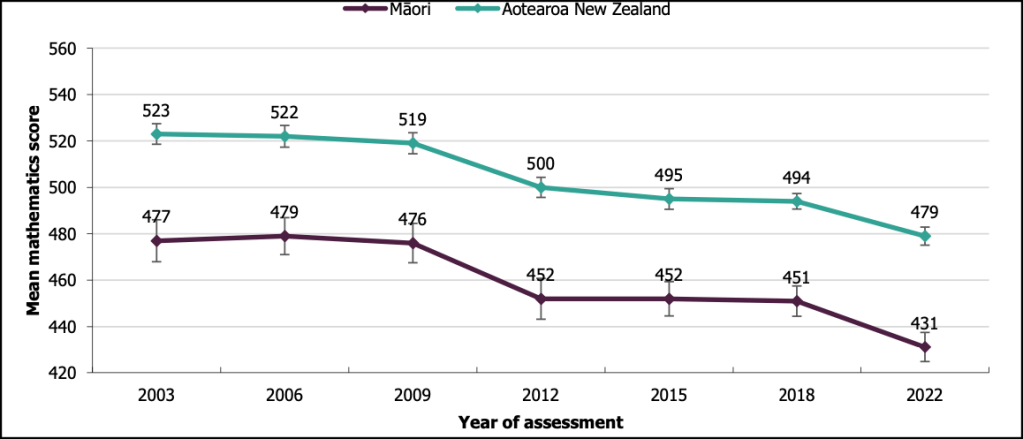
It is a trend that is sustained and consistent across learning areas and school years. For instance, the PISA data shows that Māori and Pacific students, and students from low socio-economic groups (of which Māori and Pacific students make up a large percentage), are well below the OECD average. And yes, we do have a problem with maths, but so does the whole world and we are still above the OECD average.

PISA: Māori learners v all Aotearoa learners
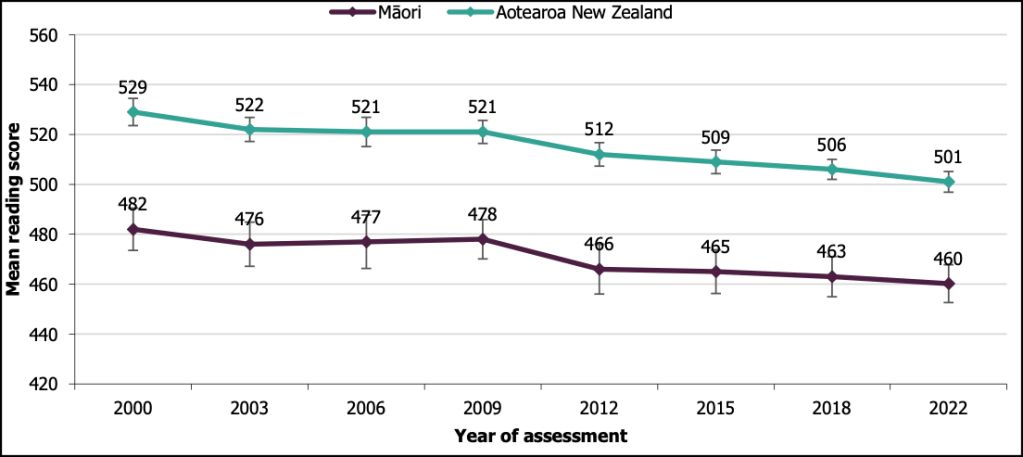
PISA: Pacific learners v all Aotearoa learners

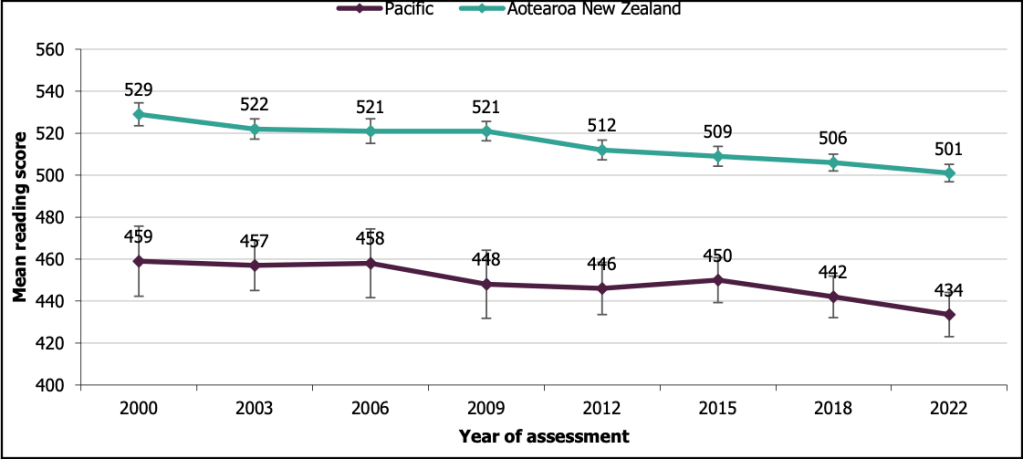
So, it is clear we have a problem: chronic underachievement by Māori and Pacific students. It is also clear that, if you are NZ European/Pakeha you are significantly less likely to fall into the underachieving category. Or, we might say, your achievement is more secure. Or, we might say, the education system caters well to your needs. The inverse of course is that it doesn’t cater to the needs of those other groups or kids. I think, for those groups, the word crisis is justified given the magnitude of the achievement gap and its persistent nature. Working to close it is urgent.
Those changes may be warranted if they sought to make the system more reflective of the needs of those most at risk — Māori and Pacific learners. But the opposite has happened. We have seen a narrowing of approaches and a reduction in the ability of schools to be responsive to the needs of the learners in front of them. These changes have been led by a small, ideologically aligned group, whose ideas have been enthusiastically championed by the Minister.
For example, that group comprises:
- Melissa Derby, our recently appointed, trans-phobic Human Rights Commissioner, who denies there is systemic racism in the education system, was on the Ministerial Advisory Group and is on the English years 0-6 curriculum writing group. (Incidentally, her appointment as HRC cut against public policy guidelines).
- Elizabeth Rata, whose extreme views on the Treaty of Waitangi are the intellectual bedrock upon which the ACT Party’s challenge of it can be found, was on the Ministerial Advisory Group and is the leader of the English years 7-13 curriculum writing group.
- Michael Johnston, who works for the New Zealand Institute, a right-wing think-tank that draws inspiration, ‘talent’, ideas and funding from the Atlas Network, led the Ministerial Advisory Group and is on ‘the science of learning’ curriculum writing group. (Atlas are a particularly nasty organisation, funded by big oil and tabacco. They have successfully funded movements to block indigenous rights around the world, that last one being fighting the referendum to give Aboriginal Australians a voice in parliament).
And, on the advice of the Ministerial Advisory Group, we have seen:
- A steady cutting of funding for education initiatives designed to improve the educational outcomes of Māori and Pacific learners, such as:
- DMIC
- The Pasifika Early Literacy Project
- Te Ahu o te Reo Maori program.
- The removal of the Treaty of Waitangi as the foundation of the curriculum, replaced instead by ‘the science of learning’ — but a narrow, materialist version of it that ignores emotions and embodiment, and other recent advances in our understanding of how we learn.
- A proposal to change the Education Act so that board priorities become focused exclusively on outcomes, and removes reference to protecting children’s rights.
These are the tip of the iceberg. Initiatives grounded in research conducted in New Zealand that show positive learning outcomes for Māori and Pacific learners are being cut. One would think they would be exactly the kind of initiatives the Minister would be championing given the specific nature of the crisis we are facing, but the opposite is happening. Indeed, there are rumours circulating that there will be no funding for any Pacific education initiatives next year.
Instead, what is being funded are offshore, unproven maths textbooks for an approach to maths dreamed up by our Minister (structured maths), and structured literacy. The senior English curriculum is being rewritten to make it knowledge-rich, with a focus on grammar and set-texts at each year level.
Confused? Because it doesn’t make a lot of sense, does it. Why would you make wholesale changes that, as one expert in Pacific education said to me, amount to a ‘reassertion of a dominant culture and language’?
“More important for the success of the Nazis was fear of unemployment among those still in work. The fear of falling radicalised the middle class and drove them towards the National Socialists.”
— from Vertigo: The rise and fall of Weimar Germany 1918-1933
This government has been very successful in convincing the country that the education system is in crisis and failing our kids. Parents, naturally, fear their child falling into the ranks of those who underachieve.
You must realise that this fear depends on failure being an ever-present feature of the system. The Minister and this government aren’t foolish idiots who don’t understand evidence. They understand it very well. They understand it so well that they know that evidence-based education initiatives that improve the outcomes of Māori and Pacific kids are a threat because they promote cultural and language diversity, strengthening different cultural power-bases.
And so, if power is to be maintained, a state of fear must be sustained. We are told the outcomes for ‘our’ kids must improve, not Māori and Pacific kids specifically. The data says for most kids in this country, their achievement is secure; they, their parents, have nothing to fear. In a system being shaped even more in their image, there may even be an improvement for them, and so the saviour will be seen as being worthy of following.
But failure will persist, intentionally, because the crisis must be ever-present, lurking, close enough to be a visible threat to the children. Our children.
All saviours need a visible failure so others fear falling. But look at who is being saved.
Erica (as our Minister has taken to signing her emails to schools recently) needs Māori and Pacific kids to fail so that the middle-class — where the votes are found — continue to believe her changes will save their kids from falling.
 Democracy Begins In The Classroom
3 responses
Thanks Bevan again a thoughtfully crafted and insightful read. Appreciate your analytical and evidence based reflections.
Thank you Rachel 🙂
[…] An education crisis made of fear […]